
 By
·
6 minute read
By
·
6 minute read
A practical, clinical-GTM guide to diagnosing and fixing MQL→SQL leaks fast.
The Structural Truth of Clinical Software Sales
If you sell specialized software, such as CTMS, EDC, eTMF, or Clinical Analytics, into the life sciences industry, you know the game is defined by high friction, long sales cycles, and limited account numbers.
We often get caught up in the big picture: the Total Addressable Market (TAM) or the Serviceable Addressable Market (SAM). But here is the harsh reality confirmed by market intelligence: TAM and SAM are often illusions.1 Chasing these broad markets leads to wasted years, high churn, and severely inflated Costs of Customer Acquisition (CAC).1
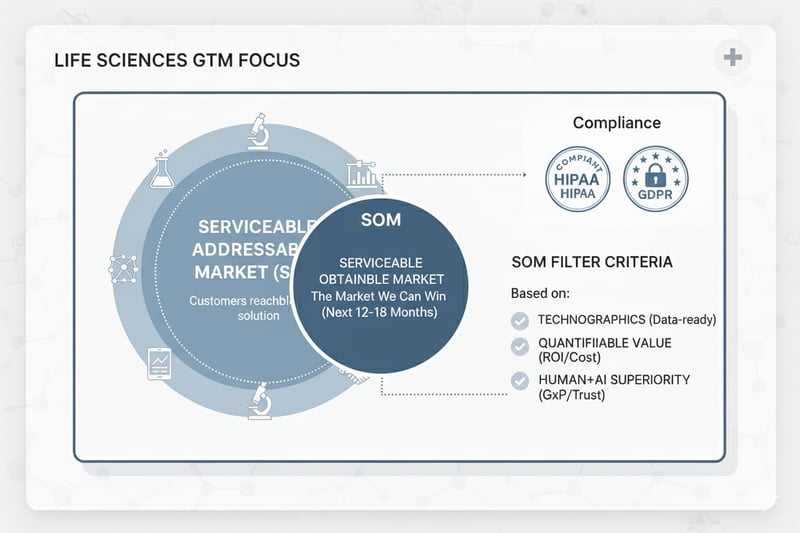
The only viable path to repeatable success in this constrained, competitive environment is focusing hyper-aggressively on the Serviceable Obtainable Market (SOM).3
The SOM is not about ambition; it is where execution happens. It is the slice of the market you can genuinely win in the next 12–18 months based on your current capacity, differentiation, and the client’s technological readiness.3
Friction 2.0: The New GTM Challenges of the AI Era
The advent of Artificial Intelligence (AI) has introduced a dual reality: it promises transformative operational efficiency, but it also creates significant GTM friction.
While AI-driven systems can accelerate trial enrolment by 10–15% and improve site selection by 30–50% 5, the sales process is now longer and more complex because AI raises the stakes on compliance.
1. The Bottleneck: GxP Validation
The single biggest new GTM hurdle is the necessity of rigorous GxP validation. AI tools used in clinical functions (like patient matching or protocol monitoring) must adhere to strict quality standards to meet EU and FDA requirements, ensuring patient safety and data integrity.6
This means your sales conversation must proactively address three core validation objections:
- Auditability & Traceability: Buyers need assurance that your AI system is fully traceable, logging everything from raw training data to final model outputs, creating a clear audit trail for security and regulatory liability.6
- Data Integrity (ALCOA): Can you guarantee the data used for training is accurate, complete, and free of contamination? GxP requires data to be Attributable, Legible, Contemporaneous, Original, and Accurate (ALCOA) throughout the AI lifecycle.6
- Bias Mitigation: Clinical buyers must ensure that AI models actively avoid biases that could exclude underrepresented populations or lead to unethical practices in critical decision-making.6
2. The Expanded Decision-Making Unit (DMU)
Selling clinical software has always involved multiple stakeholders. With AI, the DMU has expanded dramatically to include two highly risk-averse, technical groups who hold veto power over the sale 9:
- IT/Data Science: Gatekeepers for integration, security, data governance, and cloud readiness. Their focus is managing complex interoperability and scaling governance frameworks for massive cross-domain datasets.10
- Regulatory/Quality Assurance (QA): Responsible for GxP validation, auditability, and ethical bias mitigation. Their mandate is strictly about safety and integrity.6
Selling solely on speed (a clinical priority) will always hit the wall of trust (an IT/Regulatory priority). Your GTM strategy must address the priorities of both.
The SOM-Centric Playbook: Three Strategic Imperatives
To navigate the high-friction, AI-driven market, success hinges on three critical shifts:
Imperative 1: Define Your ICP with Technographics
The traditional Ideal Customer Profile (ICP), based on company size or geography, is useless in the AI era. The most important filter for defining your SOM is Technographics.13
Technographic segmentation categorizes customers based on the specific tools, platforms, and technology stacks they currently use.13 Why is this non-negotiable? Because AI utility is entirely predicated on a customer’s existing data infrastructure.11 Sophisticated AI tools will fail if the prospect relies on legacy systems, siloed data repositories, or poor data governance.10
Action: Rigorously filter prospects whose lack of centralized data infrastructure makes successful AI deployment impossible. By targeting accounts based on their existing technology stack (e.g., cloud-native platforms, specific integration tools), you drastically shrink your SOM but increase your win rate, LTV, and sales cycle velocity.13 Technographics are the gatekeeper of your truly obtainable market.
Imperative 2: Pivot to Quantifiable Value-Based Selling (VBS)
Clinical software sales cycles average 12 to 18 months or longer.15 This is far beyond the 153-day average for general pharmaceuticals.16 This extreme duration is what makes CAC balloon.2
To counteract this, you must adopt a sophisticated Value-Based Selling (VBS) model.17 Life sciences buyers (clinicians, scientists, and administrators) care about measurable outcomes, not feature lists.18
- Focus on ROI: Pivot messaging to address acute pain points like operational efficiencies, staff shortages, and cost control.18 Quantifiable case studies are crucial—show how your software delivered study setup in 10 weeks or rescued a study in jeopardy.19
- Address the Cost of Inaction: Clearly illustrate what buyers stand to lose by not moving forward, which creates necessary urgency and elevates your solution's priority.20
Imperative 3: Weaponize Compliance with "Human+AI Superiority"
In a low-differentiation, high-compliance environment, the fastest way to win is to convert regulatory adherence into a competitive advantage.
The GTM message must confront the inherent GxP risk associated with AI head-on by adopting the Human+AI Superiority narrative.21 The strategic focus shifts from guaranteeing the model’s mathematical perfection to demonstrating that the combined human-and-AI process delivers measurably better outcomes for patient safety, quality, and data integrity than the current, imperfect, human-only baseline.21
Furthermore, proactively aligning your validation processes with the FDA’s risk-based guidance (such as the 2025 draft guidance on AI to support regulatory decision-making) 22 reduces the perceived operational and regulatory risk for the buyer. By providing the documented validation required before the customer demands it, you convert compliance into a streamlined asset that significantly shortens the extensive due diligence phase.23
Actionable GTM Overhaul
The strategic focus on the SOM is the necessary foundation. Your execution plan must align sales, marketing, and crucially, legal and compliance teams.24
Here are the five critical shifts needed to implement a SOM-centric GTM strategy in the AI era:
- Re-Engineer the SOM: Use Technographic Segmentation to filter for data-ready accounts whose existing tech stack can successfully support AI integration.
- Embed Compliance: Proactively provide GxP validation evidence (audit trails, bias assessments, data lineage) as a core value feature, not just a procurement checklist.6
- Pivot to Human+AI Superiority: Frame the value proposition around how the combined human-and-AI workflow is measurably superior and safer than the existing human-only standard.21
- Tailor DMU Engagement: Develop dual-track sales narratives that resonate with Clinical Operations (speed, efficiency) and simultaneously satisfy IT/Regulatory teams (trust, security, governance).11
- Weaponize Cycle Compression: Proactively address all known objections (risk, compliance, integration) early in the sales process, using quantified ROI (e.g., 10–15% acceleration) and VBS models to build urgency.5
By strictly defining your SOM and making compliance your competitive advantage, you can transcend the market's inherent friction and achieve the high LTV required for financial viability in specialized clinical software sales
Works cited
- How Most Companies Only Define Their Total Relevant Market (TRM) and Not Their ICP | PersonalABM, https://www.personalabm.com/you-do-not-have-an-icp/
- Rethinking Sales Comp: The New Logic for Biotech & Pharma Leaders - Alexander Group, https://www.alexandergroup.com/insights/life-sciences-rethinking-sales-compensation/
- Understand TAM, SAM, and SOM for GTM Planning - fusepoint, https://fusepointinsights.com/blog/tam-sam-som-market-sizing-framework/
- The Foundation of a SaaS GTM Strategy: Focus, Feasibility, & Fit - Kalungi, Inc., https://www.kalungi.com/blog/basic-gtm-strategy-for-saas
- Clinical Trial Planning: How AI is Transforming the Process - Medidata, https://www.medidata.com/en/life-science-resources/medidata-blog/clinical-trial-planning-ai/
- How to Validate AI in GxP Applications for Life Science Companies ., https://fivevalidation.com/how-to-validate-ai/
- GxP and AI tools: Compliance, Validation and Trust in Pharma | EY - Switzerland, https://www.ey.com/en_ch/insights/life-sciences/gxp-and-ai-tools-compliance-validation-and-trust-in-pharma
- Building blocks: The ultimate guide to AI in clinical trials | Medable, https://www.medable.com/knowledge-center/guides-building-blocks-the-ultimate-guide-to-ai-in-clinical-trials
- AI-Driven Clinical Decision Support Systems: An Ongoing Pursuit of Potential - PMC, https://pmc.ncbi.nlm.nih.gov/articles/PMC11073764/
- AI Data Governance in Healthcare: What's New and What's Changing? | HealthTech, https://healthtechmagazine.net/article/2025/02/ai-data-governance-in-healthcare-perfcon
- AI Data Governance in Healthcare: What's Happening and What's Next? | KMS Technology, https://kms-technology.com/ai-data-governance-in-healthcare-whats-happening-and-whats-next/
- A Scientific Guide to Vertical Market Penetration with AI - Octave, https://www.octavehq.com/post/a-scientific-guide-to-vertical-market-penetration-with-ai
- What Is Technographic Segmentation? - Delve AI, https://www.delve.ai/blog/technographic-segmentation
- Mastering GTM Strategy: Leveraging ICP for Market Success - RevenueBase, https://revenuebase.ai/perfecting-your-gtm-strategy-it-all-begins-with-your-icp/
- Accelerating the Medical Software Sales Cycle in 2025: Strategies to Shorten the Long Wait, https://martal.ca/medical-software-sales-lb/
- Average Sales Cycle Length by Industry: 2025 - Focus Digital, https://focus-digital.co/average-sales-cycle-length-by-industry/
- MedTech Pricing Trends: Innovations Shaping Sales in Healthcare | AI-Powered CPQ, Dynamic Pricing, & Revenue Software - PROS, https://pros.com/learn/blog/medtech-pricing-trends-innovations-shaping-sales-healthcare/
- Successfully selling technology into healthcare and life sciences organisations, https://www.livingbridge.com/livingroom/successfully-selling-technology-into-healthcare-and-life-sciences-organisations
- Clinical Trial Enablement Case Studies - Clario, https://clario.com/resources/case-studies/
- Value-Based Selling: Benefits and Strategies - RAIN Group, https://www.rainsalestraining.com/blog/value-based-selling
- When "Imperfect" AI Models Still Add Value In Pharma Quality - Clinical Leader, https://www.clinicalleader.com/doc/when-imperfect-ai-models-still-add-value-in-pharma-quality-0001
- Artificial Intelligence for Drug Development - FDA, https://www.fda.gov/about-fda/center-drug-evaluation-and-research-cder/artificial-intelligence-drug-development
- The FDA's Draft Guidance for AI in Clinical Trials: Implications for Sites and AMCs, https://realtime-eclinical.com/2025/02/06/the-fdas-draft-guidance-for-ai-in-clinical-trials-implications-for-sites-and-amcs/
- What Is a Go-to-Market Strategy (And Why Do You Need One)? - Salesforce, https://www.salesforce.com/sales/go-to-market-strategy/
- AI, Data Analytics & Research | Joint Commission, https://www.jointcommission.org/en-us/about-us/key-initiatives/ai-data-analytics-research
- How to Shorten the Sales Cycle: 20 Strategies to Streamline the Sales Process | NetSuite, https://www.netsuite.com/portal/resource/articles/crm/how-to-shorten-the-sales-cycle.shtml
Connect with Tessarai today to discover how we can help you achieve operational precision and sustainable growth. Visit our Contact Us page to start the conversation.